Berklee on the Road Marks Milestones in Puerto Rico and at Umbria Jazz
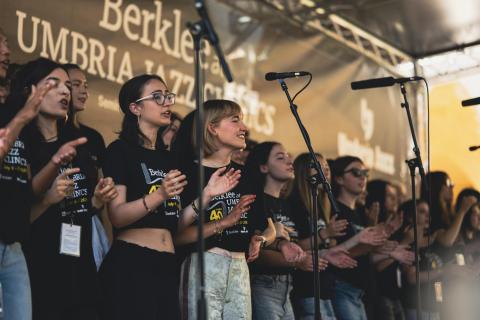
Students performing in the 2025 Berklee at Umbria Jazz Clinics Gospel Ensemble.
Image by David Morresi
Music needs time to unfold: It emerges out of silence, develops its themes in real time, and—every musician hopes—leaves its listener changed. It's a temporal art, as opposed to spatial arts like painting or architecture that exist all at once in two or three dimensions. In music, the space might provide important context and inspiration (Jarrett’s Köln Concert couldn’t be the same as Lausanne) but no piece of music happens to us in an instant.
The same is true of initiatives that develop musical talent. They need space to take root—say, classrooms and stages in Boston, Puerto Rico, or Italy—but most of all, they need time to unfold, for lessons and relationships to deepen, and for their life-changing influence to be fully reckoned.
For Berklee’s two longest-running global partnerships, Berklee in Puerto Rico and Berklee Clinics at Umbria Jazz, 2025 marked major milestones: a 30th anniversary for the former, and a 40th for the latter. Alumni and faculty traveled to Puerto Rico and Perugia, Italy, to join current students in celebrating the friendships, careers, and music that have unfolded since the first notes were struck in those hot summer classrooms. And even as we looked back—to Puerto Rico in the ’90s, to Perugia in the ’80s—a new cohort of students and faculty was playing us into the future. Like witnessing music many years in the making, we heard echoes of long-established themes, and we listened for what would come next.
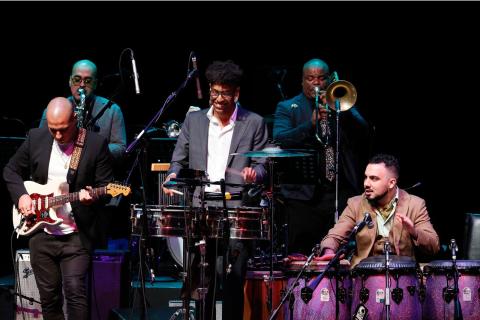
Berklee Alumni and guest artists performing at the Berklee in Puerto Rico 30th Anniversary Concert.
Dariel Peniazeck (Electric Guitar); Kalani Trinidad '12 (Tenor Sax); Marcos López '11 (Timbales); Hommy Ramos (Trombone); David Antonio Rosado Ortiz '24 (Congas); Julio Alvarado (Trumpet - behind Marcos)
Image by Joe Colón
Berklee in Puerto Rico
On a warm June afternoon in Caguas, Puerto Rico, 17-year-old violist Sergio Ortiz stood outside an open-air classroom, running scales he’d just learned from a Berklee faculty member. For Ortiz, returning to Berklee in Puerto Rico for a second straight year felt like stepping further into his future.
“I wanted to expose myself to other things,” Ortiz said, “and I was like, ‘Let’s try something new.’” A fan of jazz, he soaked up lessons in improvisation and theory—material that, he said, blew his mind. Even a class geared toward woodwind players offered unexpected insights; Ortiz adapted breathing techniques from instructor Jonathan Suazo and incorporated them into his own practice.
For three decades, Berklee in Puerto Rico has provided exactly that kind of inspiration and discovery. Founded in 1995 by music educator and former Berklee trustee Luis Álvarez BM ’83, in partnership with the late Larry Monroe ’69, the program has introduced more than 4,000 young musicians to Berklee’s signature approach: rigorous musical training paired with live performance and mentoring from top-tier artists and faculty.
The idea was sparked by Álvarez’s own Berklee experience in the early ’80s, where faculty blurred the lines between classroom and stage. A bassist and composer, Álvarez envisioned a summer program aligned with the Heineken Jazz Festival—now the Puerto Rico Jazz Festival—so students could learn from Berklee faculty by day and see them perform by night.
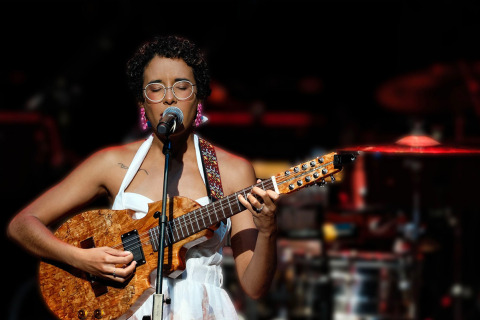
Fabiola Méndez BM ’18 performing at Berklee in Puerto Rico 30th Anniversary Concert.
Image by Joe Colón
Monroe, who spent four decades at Berklee as a faculty member, department leader, dean, and vice president, helped turn that vision into a reality. Alongside Gary Burton ’62 ’89H, Monroe helped launch Berklee on the Road, the broader initiative that gave rise to Berklee in Puerto Rico.
The 2025 program ran from June 2 to 8 at Escuela Libre de Música Antonio Paoli in Caguas. Each day, students buzzed between sessions on music theory, improvisation, ensemble performance, and more. Outside, they gathered in the courtyard to rehearse and connect; inside, classrooms pulsed with rhythm and discovery.
For many Berklee faculty, the program is just as meaningful for them as it is for the students.
Eguie Castrillo, percussionist and Berklee professor, has returned every summer since 2004. “The students are amazing,” he said. “It’s a way for me to give back.”
Rebecca Cline, professor of piano, first attended the program as a student in 1996 and now returns each year to teach. “I really like finding people who are looking for the same thing I was looking for,” she said. “I have a real soft spot in my heart for the island. It’s part selfish and part wanting to give back. This place really gave me my start.”
The program also serves as a pipeline to Berklee itself. Students can audition for admission and scholarships during the weeklong intensive, and many go on to attend the college. One of them is Rubén Amador BM ’01, who took part in the inaugural year and now leads the Conservatorio de Artes del Caribe (CAC), Berklee’s Global Partner school on the island.
Many students, like Amador once did, return multiple times—testing the waters in year one, digging deeper in year two, and eventually preparing to apply to Berklee. “By the third year, they’ve decided they want to continue their education at Berklee,” he said. “And because of the ecosystem, they get to Berklee prepared.”
The program culminated in a 30th-anniversary tribute concert on June 5 at the Centro de Bellas Artes Luis A. Ferré in San Juan. The celebration featured performances by alumni and faculty, headlined by saxophonist Miguel Zenón BM ’98, an alum of the college and Berklee in Puerto Rico. Musical director Edmar Colón BM ’15 MM ’16 led the concert, with a lineup including Fabiola Méndez BM ’18, Marcos López BM ’11, David Antonio Rosado Ortiz BM ’24, David Rivera ’08, and Zayra Pola Ocasio ’13.
In the audience were students, families, and friends of the program, along with very special guests. Rita Monroe, Larry Monroe’s widow, alongside their son, daughter-in-law, and Rita’s sister, Paula, all gathered to honor Monroe’s legacy following his passing in 2024. During the event, Álvarez was honored with an Alumni Achievement Award for his decades of dedication to the program and to music education in Puerto Rico.
As Berklee President Jim Lucchese said at an alumni reception the night before the concert, “The soul of Berklee is deeply connected to Puerto Rico, and it’s also clear—as we’ll see tomorrow night—that the music and soul of this place is deeply connected to Berklee.”
Reflecting on the students, Cline shared what she hopes they take away: “Probably the same thing that I was excited about as a student, which is just knowing that there’s a community of people insanely interested in studying music, just like I was. And the knowledge that they’ve found their people.”
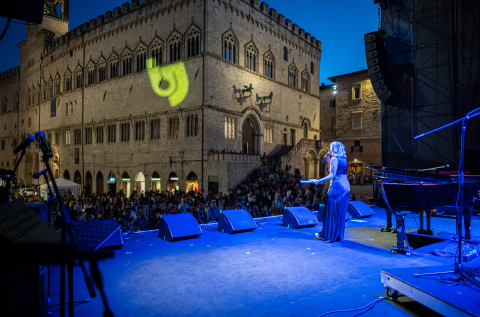
Rosaria Renna, Italian radio and television host, welcoming the audience to the Berklee at Umbria Jazz Clinics' 40th Anniversary Concert held on the Piazza IV Novembre Stage (Perugia, Italy, July 10, 2025).
Image by David Morresi
Berklee Clinics at Umbria Jazz
If you had been strolling the courtyard of Perugia’s San Paolo school any day in mid-July, you might have witnessed this:
A young woman picking intently at her acoustic guitar on the cloister's stone bench, rehearsing for an admissions audition. Down the bench, another student holding a phone playing music up to the ear of a third, who is matching the song's saxophone solo note for note on his own instrument.
A glorious cacophony of ensembles seeping kick drum–first from classroom doors kept ajar to cool the centuries-old former convent.
More young people, from some 30 countries, chatting in various languages, exchanging contact information, favorite musicians, alternate guitar tunings, and aspirations.
The inimitable voice of Professor Dennis Montgomery crossing impossible expanses of pitch to demonstrate for an ensemble of more than 20 singers every vocal part to the 1979 disco smash hit "Ring My Bell." (Montgomery watches the class as he accomplishes this feat. "The look on your faces is priceless," he said. "Don't worry, you'll get used to me." The way their laughter follows—you can tell that's already happening.)
Cicadas grinding overhead like pepper mills in an endlessly shifting minimalist phase.
A crowd of students clustered around Zahili Gonzalez Zamora's piano classroom, where an impromptu jam session has erupted from the end of a lesson on the importance of under-celebrated women jazz pianists. Riffing on Tania Maria's "Yatra-Ta" are three students at three upright pianos, Gonzalez Zamora at an electric piano, and a drummer who'd been passing by the classroom and couldn't resist sitting in. Perhaps the drummer had taken to heart a story bassist Matthew Garrison ’94 shared that week, about his habit at Berklee of carrying his amp around rehearsal spaces and (with permission) hopping into practice sessions that looked like they could use a bass.
In short, you would catch a glimpse of the musical ambition, community, and joy that's been overflowing from Berklee's clinics at the Umbria Jazz Festival in Perugia, Italy, for decades. And you would understand that, even before all the skills gained and scholarships granted and lives transformed, these would be reasons enough to celebrate the 40th anniversary of Berklee's longest continuously running global partnership.
The clinics began in the ’80s as a handshake agreement between founding festival director Carlo Pagnotta and artistic director Giovanni Tomasso on one side and Berklee's second president, Lee Berk, and longtime administrator-of-many-titles Larry Monroe on the other. Tomasso said he selected Berklee for the partnership because he had become familiar with the school's correspondence courses through a friend. "He let me read some of the material, and I fell in love," he said.
"We were kind of making it up as we went along," remembers Jim Kelly, professor of guitar, who was at that first clinic and has been to some 30 total editions of the clinics. And he means that quite literally, as he composes new pieces for the Umbria Jazz classroom each year. "If I have things I can give them that are new, you know no one else is going to be doing it."
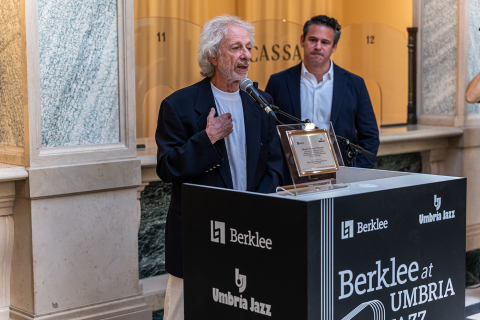
Giovanni Tommaso, artistic director, Berklee at Umbria Jazz Clinics
Image by David Morresi
"You can change the direction of a life in an hour," said Dave Limina, chair of the college’s Piano Department, when asked what these clinics can accomplish in such a short amount of time, "if they're hearing the right things from the right people, and all of our faculty are not only world-class active performers but some of the best jazz educators in the world."
Indeed, many of the lessons are of the deceptively-simple-but-endlessly-deep variety. Drummer Ron Savage, Berklee's interim provost, explaining that "people with exceptional talent practice the most." Trumpeter Phil Grenadier, associate professor in the Ensemble Department, parsing the difference between chops and tone—"you could play the hippest stuff in the world, but if your sound's not happening, no one's gonna want to hear it." Montgomery, choir director and professor in the Ensemble Department, on the importance of balance and vocal control— "the objective of singing in a group is listening to each other."
The other draw for the clinics was—and remains— to combine that world-class musical instruction with the exposure of a world-class music festival. Students study in the clinics by day, and use their included festival passes to catch shows in the evening. "The festival combined with the course makes it a really unique experience, because you have all these incredible musicians coming in and out," said UK bassist Holly Reinhardt, who returned for a second year at the clinics in 2025.
"The whole experience was just life-altering," said Garrison, the only American student to attend the clinics' first year, who says it's in all those spaces between the classroom and the stage where the program shows its true worth. "You would be walking down the main strip, and Miles Davis is taking some coffee. Gil Evans is just sitting on the side of the street reading a newspaper. You'd run into Delmar Brown . . . and you could talk with him."
"You would be walking down the main strip, and Miles Davis is taking some coffee. Gil Evans is just sitting on the side of the street reading a newspaper."Matthew Garrison ’94
Over the years, the clinics' reputation grew alongside the festival, and their draw expanded from Italy through Europe and around the world. "Knowing what I know about being a young musician, a young music fan: everyone aspires to come here to perform or . . . to listen to the greatest jazz in the world in such a beautiful space," said Berklee President Jim Lucchese at a 40th anniversary celebration for the program. "And those same musicians 32 aspire to Berklee."
"The magic of this relationship," Lucchese added, "is driven by the people who have a vision to see this, and the shared vision and love of developing, identifying, mentoring, and then watching that young talent grow and develop on."
"There are so many musicians around the world who can't get to us in Boston," explained Jason Camelio, assistant vice president of global programs and partnerships. "The concept of Berklee on the Road is we're gonna bring Berklee to you." He sees that outreach having real effects on Berklee's community. "In recent years, we've seen an explosion in our enrollment from people who are coming from this program," he said. All the while, the influence and impact of the program are expanding. "Now we're seeing these grand-students [second-generation students] and great-grand-students."
"The legacy is huge," said Limina. "It's global."
If, on the evening of July 10, you'd strolled from San Paolo up the hill (or through the hill, using the city's string of underground escalators) to the city's center, Piazza IV Noviembre, you'd find one of the world's great jazz festivals just about to kick off. It's hard to overstate the layers of history that converge at the site of the Umbria Jazz Festival's opening night of Berklee-led concerts. You could go way back to the ancient Etruscan acropolis in the caverns beneath our feet. Or consider how that ancient settlement mingles with the city's later Roman foundations, whose own ruins were repurposed into medieval structures and Renaissance fortifications, given Baroque touches, and at least partially modernized (the escalators, after all) over the 20th century. And on top of all that history: a stage, where multiple generations of alumni and educators—some who were present for the program's first year in 1985 and others here for the first time—came together to honor the legacy of a program that's served more than 7,000 students and awarded more than $60 million in scholarships over the past four decades.
Among the performers that night were the Berklee clinic alumni: pianist Mathis Picard, saxophonist Marco Guidolotti, pianist Alessandro Lanzoni, guitarist Daniele Cordisco, drummer Roberto Giaquinto ’09, 15-year-old drummer Antonio Lo Conte, winner of the 2023 Tour Music Fest best junior drummer award, and Garrison on bass.
“In this beautiful old town, it’s new versus old,” said Garrison. Making music in Perugia surrounded by history both ancient and more recent—think of the jazz legends taking their afternoon espressos in the cafes, the students whose music bounced off these stone walls—"you start doing this little time travel thing between the various offshoots of creative expression. . . . This is almost like this paradise when all those things converge."
This article originally appeared in the spring 2026 issue of Berklee Today under the title “Time Travel.”