Heat Wave: Inside Miami's Sizzling, Boundary-Blurring Latin Music Scene
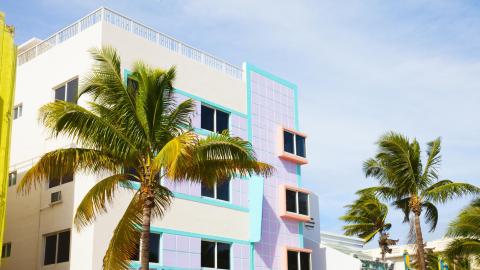
Image by Stella Levi
Down there: That's Miami.
"Mayami, mijo,” a Cuban lady says.
The 305, reads a guy’s cap.
Out the window we see waves lapping against white sands.
Then, further west, massive street murals. South of that, the Freedom Tower, where my grandparents, my mother, and countless other exiled Cubans first received help when they arrived in this country. Directly across is the Kaseya Center. Rubén Blades ’06H was there in May, cantando con alma de barrio, chatting about his Gabriel García Márquez-inspired album and how he’d tried convincing “Gabo” to cowrite it.
Oh look: gators sunbathing on a golf course.
Our plane lands. And there’s clapping!
Join in. It’s music.
Before Grammy winner Tommy Torres BM ’93 was releasing chart-topping hits as a solo artist and producing for the likes of Ricky Martin, Jesse & Joy, and Alejandro Sanz ’13H, he was an assistant engineer for Sony in New York, watching sessions with Michael Jackson and Nirvana. But he hadn’t been promoted in years, so he started making demos in those same studios at night and sending them everywhere.
One day, demo in hand, he snuck into the office of fabled A&R VP Tomás Muñoz, who was on the phone saying that Ricky Martin shouldn’t thank his grandmother in his album Vuelve because it went against the “international, seductive man” they were portraying. Basically, “James Bond would never do that,” laughs Torres. Muñoz kept his demo and said, “No more intrusions.” Some time later, he said it was clear that music was Torres’s calling and he’d have a career in it. “But why are you here?” Muñoz said. “I’m the only one working in Spanish and I’m retiring. Move to Miami.”
Two months later, Torres was driving a U-Haul with his girlfriend. He says: “The guy couldn’t have been more right.”
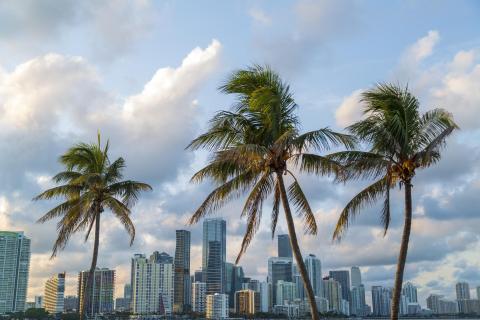
Palm trees swaying in front of the Miami skyline
Image by Michael Russell
Miami-Dade is the country’s only county where most residents are immigrants. Spanish is king and an ear for accents is queen. Un cubano is a sandwich, a coffee, and a Cuban man. The nightlife’s intense but not all flash and velvet ropes. Wildlife abounds; tourists, too. Home for many locals is still beyond the sea. Even so, for singer-songwriter Nicolle Horbath BM ’22, “Miami feels very close to Barranquilla, and feeling rooted helps inspire me.” In 2024, her Latin Grammy nomination for Best New Artist was announced here by fellow Colombian Juanes.
Miami’s less a US city, more a tropical meeting place for Latin America. And for decades it’s been a prominent global hub for Latin music, though partly thanks to digital media, artists no longer feel obligated to record their breakout album here. Many whose music is produced and managed in Miami live abroad, working here occasionally, if at all. Still, the city’s home to numerous studios, labels, producers, songwriters, artists, and icons (like Gloria and Emilio Estefan ’07H). And, in recent years, Berklee alumni have become increasingly vital to that mix. EDM, hip-hop, jazz, and others are smaller yet notable parts of the industry (160,000 attended last year’s Ultra Music Festival, and the city’s a magnet for DJs worldwide).
It’s tough to pin down Miami. But at its core, it’s a vibrant concoction as porous as its limestone foundation, absorbing all the sazón, sounds, and stories touching its shores.
Explosion, fever, craze! You’ll often hear those words describing Latin music’s popularity, as if it’s a sudden, singular phenomenon. But the category covers a sweeping range of music from many countries, so different time periods mean different mainstream sounds. And Latin music’s global popularity has ebbed and flowed for over a century, starting with tango in Europe, then rumba and other Cuban styles creating hits featured in Hollywood’s early sound films.
Fast-forward through various swells of salsa, Latin pop, regional Mexican, rock en español, and many others, and you reach this century’s first global wave. Actually, it really kicked off in 1998, with Ricky Martin’s thrilling “La Copa de la Vida” performance at the World Cup Final in France—over a billion watched—followed by another rendition at the ’99 Grammys, the elaborate production getting a standing ovation.
Torres arrived in Miami in 1999, and it wasn’t long before he was producing multi-platinum artist Ednita Nazario, who recommended him to Martin. His career boomed afterward, earning multiple accolades, including a Berklee Alumni Achievement Award in 2023. Two decades on, Torres says that if, in the afterlife, he could show his work to “John Lennon and other artists . . . I’d choose some of my own music, though it’d be easier to share what I did for Ricky”—especially the MTV Unplugged album. The 2006 record was hard to mess up given Martin’s amazing repertoire, Torres explains. But his arrangements helped show “a Ricky we hadn’t seen” on stage: spontaneous, relaxed, with no choreography or intricate production. And in a pioneering concept, Torres suggested featuring native Puerto Rican instruments and music, especially in “Tu Recuerdo” and “Pégate,” new songs he produced and cowrote. Now when he hears the cuatro playing around the world and people singing those songs, he proudly feels he “fulfilled the musical and the cultural, patriotic part” of being an artist.
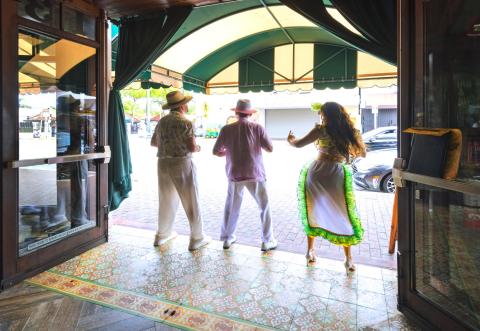
Cuban salsa dancers in Little Havana, Miami.
Image by John Coletti
Several years after “Gasolina” was released, I was in a club in Shanghai when suddenly the song’s revving intro took over, and everyone was dancing to what my friends and I’d been partying to for years back home in Puerto Rico: reggaetón. I took in the scene, full of goosebumps. I didn’t expect a generation of reggaetón superstars—most already known in PR—would follow, redefining mainstream Latin music. More surprising was that 13 years after “Gasolina,” Daddy Yankee struck again with an even bigger song, Luis Fonsi’s soulful voice taking the lead while the Puerto Rican cuatro played throughout.
As the whole planet knows, “Despacito” was a monster hit. The video is YouTube’s second-most-watched ever. Even covers in countless languages went viral. The song (and what followed) gave Latin music so much extra fuel that “it feels like the up and down is over,” says producer and engineer Carlos Perez de Anda BM ’14. Globally, “Latin music is here to stay.”
In 2017, US Latin music revenues jumped 37 percent, then crossed $1 billion for the first time in 2022, according to the RIAA. In 2024, recorded music revenues in Latin America rose 23 percent, reported the International Federation of the Phonographic Industry. Throughout Europe, artists such as Karol G, Christian Nodal, and Rosalía pack arenas. “I haven’t seen a place Latin music is not touching,” says Rodney Alejandro BM ’97, dean of professional writing and music technology at Berklee. He points to Jay Chou, one of the Chinese-speaking world’s biggest artists, adopting Latin pop in “Mojito,” and to K-pop companies launching Latin operations (e.g., HYBE). Fresh sounds are trending—like those of Peso Pluma and Elena Rose—as are collaborations with famous Asian performers—take J Balvin’s and Badshah’s trilingual “Voodoo,” and Lisa featuring Rosalía in “New Woman.” Topping it all is mega-star Bad Bunny: Spotify’s most-streamed artist worldwide last year and from 2020 to 2022, who’s appeared in movies, ads, SNL, the WWE, the Met Gala—everywhere—and, as everyone knows, headlined this year's Super Bowl halftime show, performing entirely in Spanish.
“I’m constantly getting requests from Japan [and London] for ‘Livin’ la Vida Loca.’ All the Ricky Martin stuff from the late ’90s, they love,” says Javier Mendez BM ’08, senior manager in sync at Warner Chappell Music in Miami. “And FIFA,” the soccer gaming series, “uses lots of Latin music. It’s an amazing soundtrack everybody wants to be on.” Mendez also describes how, after learning that “Disney was making a movie about a little Mexican kid,” he sent production their best Mexican talent, and Natalia Lafourcade was picked to perform “Remember Me” in Spanish for Coco. “I was super excited. I tell them: ‘If it gets nominated, she needs to play at the Oscars.’ I don’t know if it was me that did it, but it happened [in 2018’s ceremony]. It’s one of my favorite career moments.”
"I haven't seen a place Latin music isn't touching."Rodney Alejandro BM ’97
Drawing people from Los Angeles, New York, and abroad, Miami’s industry grew not just because of Latin music’s record numbers—it was the pandemic. “Out of nowhere there was a huge Berklee community,” says Andrés Arenas MA ’22, junior A&R manager at Warner Chappell. “The expansion was on the verge of happening,” Mendez adds, but Miami’s minimal restrictions, warm weather, and then-cheaper cost of living sped things up, “kickstarting the industry 15 years,” Perez says. Various labels here broadened their business operations, he adds, including Sony Music Latin, which also opened 5020 Studio. Interscope Miami launched too, headed by Nir Seroussi BM ’96. “Industry people from all walks of life moved here,” says Perez. Meeting by chance at a showcase, he and Mendez told their connections at Berklee about the upswing and, eventually, Miami was added to the Berklee Career Center’s slate of student industry trips.
In 2017, as “Despacito” climbed the charts, Perez left LA, where he’d worked under Tony Maserati with Beyoncé, Lady Gaga, and others. The move was meant to be temporary, but after quickly finding lots of opportunities and meeting his future wife, he’s still in Miami. He’s now manager and chief engineer of Alacran Studios, which he helped build from scratch. (Warner Chappell is a longtime client; both businesses have nearly all-Berklee teams.) Alacran opened right before lockdowns, so work came sparsely. Eventually, Luis Enrique, who Perez says “can make a record with a straw,” called with an ambitious project. The fusion-heavy album, full of unique instrumentation, was unlike anything the Prince of Salsa had done before. While 12 Latidos remains unreleased, word of the project online helped Alacran generate serious buzz at the time.
Torres also experimented during the pandemic. For the first time, another artist-producer—Bad Bunny, no less—wanted to be his copilot. “It sounds so crazy . . . I have to do it,” Torres thought initially, their music being so different. Nevertheless, both had the same approach: zero preconceptions and let’s-play-around vibes. “I imagined myself in a band . . . where differences create interesting things.” Bad Bunny spat rhymes nonstop, then instantly spat more if Torres wasn’t convinced, writing nothing down yet remembering everything. And Torres, who’s always “found melodies and chords easily by ear” with any instrument, captured ideas on pianos, guitars, and more. Sometimes he’d adapt lyrically and musically to his coproducer’s rap phrasing. Sometimes his collaborator composed to Torres’s melodies. Everything was completed “in record time,” and the seemingly madcap venture became a joyful, creatively freeing partnership called El Playlist de Anoche.
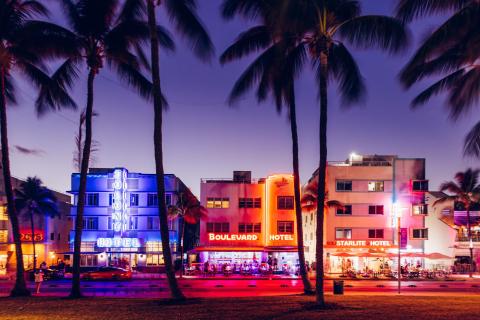
Art Deco hotels on Miami Beach at night
Image by Alexander Spatari
When asked what Miami needs musically, nearly everyone said more live venues, especially for smaller acts and newcomers. Of those, there’s ZeyZey, the Miami Beach Bandshell, Lagniappe, and Savage Labs, among others. But live music culture is far from ingrained, and locals prefer mainstream acts, their tastes varying otherwise, given their diversity. “Berklee performers tend to struggle here,” Arenas says, citing Pitbull as Miami’s only native, top Latin talent. Historically, this hasn’t been “a place where artists develop. They come to work, but their careers and fan bases are in other countries. Here’s where everything happens and nothing happens,” says A&R director at Warner Chappell Mariana Zawadzki, who completed a general music studies certificate from Berklee Online in 2023.
Miami and Latin music, fundamentally driven by immigrants and their mobility, are also facing greater dilemmas given US policies and attitudes. “It’s unfortunate. Because while all these great things are happening, Latinos in this country feel targeted,” says Perez. However, “it’s also making us want to showcase more who we are. I feel like repression always does that.” Berklee community members in Miami are from Ecuador, Colombia, Chile, Peru, Argentina, Puerto Rico, Dominican Republic, Spain, Venezuela, and elsewhere, reflecting the industry makeup. For some, even everyday situations feel tense. As promoters, cities, and states lose money from canceled shows (some artists’ visas have been denied or revoked), Torres hopes that such significant business consequences lead to objections and shifting positions.
Still, Miami remains a crucial bridge between several markets, hosting an unparalleled variety of sounds and talent, with key insights into the different trends and audiences across Latin America. “If you want to be a producer, or work on the Latin industry’s business side, Miami’s your place,” says Hugo Avendaño BM ’19, A&R analyst and operations manager at Warner Chappell. And Latin-Anglo dividing lines are increasingly blurry: Bieber, Beyoncé, and Drake guesting in Latin hits, singing in Spanish; country artists joining regional Mexican acts; Bad Bunny headlining Coachella. But barriers endure. Zawadzki says that getting a top Latin producer sessions with Anglo artists was grueling. She feels “the general market pushes to be part of what’s trending, whether it’s Latin or Afrobeats . . . but there’s still no give-and-take.”
Soon, Latin and Anglo music will be equally popular worldwide, and it’s not just because mainstream Latin keeps evolving through fusion, collaborations, and experimentation (take Residente’s self-titled 2017 album as a master class of all three). Honestly: Who’s heard salsa, merengue, bachata, tango—all taught on every continent for decades—or lots of other Latin genres, and not wanted to dance? Global adoption also continues, from Japan (among many, the Tokyo Cuban Boys, active since 1949) to Senegal (Orchestra Baobab). Multicultural places like Miami, well equipped to navigate all these varied landscapes, stand to benefit.
“If you want to be a producer, or work on the Latin industry’s business side, Miami’s your place.”Hugo Avendaño BM ’19
You’re in South Beach (the beach, mijo), where Alacran’s cozy vibes help Carlos work with Shakira. Meanwhile, Javier’s upstairs playing the güiro he keeps at Warner Chappell, avoiding the evening rush hour. Then he’ll rehearse with his Latin punk band.
A friend texts you about a concert at Ark for Art—Nicolle performed there in April, actually. But first: dinner. Instagram says there’s a food truck event with arepas, sushi, ceviche, akra, kosher burgers, Korean-style wings, truffle croquetas . . . yes, please!
Traffic’s insane (and Art Basel hasn’t even started). A speedboat in tow nearly hits you and several people fishing from a bridge—a Florida Man story, almost.
Later, “Tu Recuerdo” plays on your speakers. You remember Tommy’s feeling rock for his next project. But he’s also feeling going back to Puerto Rico’s native music and instruments.
At the event, a tropical Latin funk/electropop/ something else group is on stage; their conguero has mad skills. The street artists making pop-up pieces are also killing it. All help you deal with the long lines and the mugginess, as did the free warm colada shot earlier and the cold Tripping Animals IPA in your hand. Waiting for your friends, a thousand accents and languages and colors and outfits and beautiful people and smells and flavors and melodies hit you all at once, as if in sync.
This article originally appeared in the spring 2026 issue of Berklee Today under the title "Heat Wave."