Meet the Berklee Student Setting Planetary Motion to Music
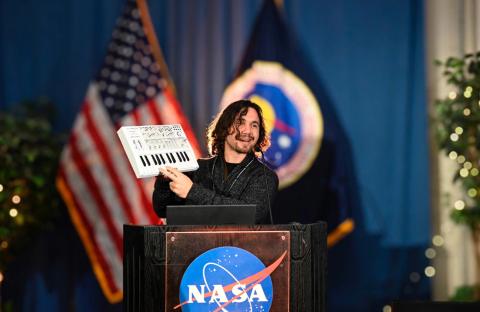
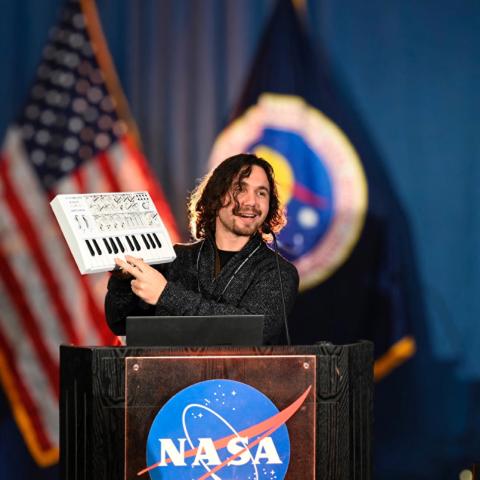
Javier Roqueni demonstrates SoniKosmos at SpaceCHI 2026, a global conference on human-computer interaction in space exploration, held at NASA’s Ames Research Center in Silicon Valley.
Image by Marina Vanderdonckt and Tommy Nilsson
What does the solar system sound like?
Berklee College of Music student Javier Roqueni BM ’27 just might have the answer. Roqueni’s compositional interface, SoniKosmos, enables musicians to convert planetary motion into music.
The technology not only unlocks new creative possibilities for composers and musicians, but it allows them to make music in alignment with actual planetary movements in real time.
“This opens so many harmonic doors for composers, because we’ve already exhausted our traditional tonal system in the Western world,” says Roqueni, who is double majoring in composition and electronic production and design.
SoniKosmos derives its musical frequencies from the changing orbital speeds of planets, and turns them into a pitch that can be played through any electronic or acoustic instrument. Because each planet moves independently, their notes combine to form a different musical arrangement every day, creating infinite possibilities.
Roqueni’s system relies on NASA’s Jet Propulsion Laboratory Horizons platform, which provides 17,000 years of astronomical data to the public, to calculate the angular velocity of each planet and translate those frequencies into music. “Spacecraft use this data to navigate the solar system. SoniKosmos uses it to navigate its harmony,” Roqueni explains. In his sonification framework, each date in history has its own tonal scale.
“After venturing into this system, I've completely opened my mind about what music is,” Roqueni says. “It is so new that you have to guide yourself by ear. You cannot guide yourself by rules, and that’s very powerful, especially after studying so many rules about music. It’s a new land to explore.”
“After venturing into this system, I've completely opened my mind about what music is. It is so new that you have to guide yourself by ear. You cannot guide yourself by rules, and that’s very powerful, especially after studying so many rules about music.”
—Javier Roqueni
SoniKosmos uses Hertz (Hz) to measure the frequency of each musical note generated from a planet’s movement around the sun. The higher the frequency, the higher the pitch. Roqueni even discovered that on certain dates, the planets produce unusually harmonious combinations, inspiring him to create what he calls a “harmonic almanac” that charts the rarest musical alignments. For example, the planets aligned only once on a Lydian dominant scale this year.
“Every day is a unique world. Today’s chords, for example, could be a pentatonic scale or a major scale. Your birthday could be a diminished scale,” he says. “Rarely, you’ll find a perfect fifth, a perfect sixth. What you will find are unique harmonic relationships that sit in between the ones you’re used to.”
Before attending Berklee, Roqueni studied audio engineering in Mexico City. He initially enrolled in Berklee Online courses and eventually secured a scholarship to study at the college’s campus in Boston, where he explores the intersection of music, science, and technology. His continued studies at Berklee are made possible by the Lookout Foundation, which supports students working to make a difference in the world.
Now, he is using SoniKosmos to expand on the work of ancient Greek philosopher Pythagoras and seventeenth-century astronomer Johannes Kepler, both of whom investigated links between planetary motion and music. Roqueni is taking the next step.
“We already have the technology. Why don’t we actually create a system, not only for science, but for musicians, to compose and create with celestial harmony?” he asks.
Here on Earth, SoniKosmos is garnering attention. In September, Roqueni was invited to present the technology at SpaceCHI 2026, a conference focused on human-computer interaction in space exploration held at NASA’s Ames Research Center in Mountain View, California. There, he demonstrated SoniKosmos using a synthesizer loaned from Berklee’s Electronic Production and Design (EPD) Department.
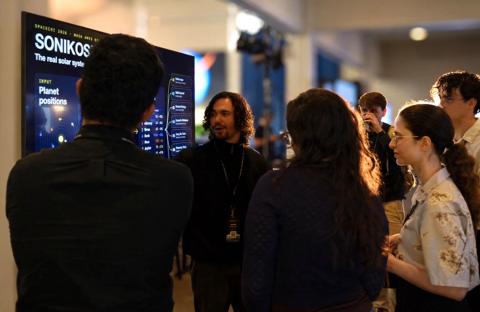
Roqueni shows SpaceCHI 2026 attendees how SoniKosmos uses NASA data to calculate planetary frequencies and derive musical scales from them via the Jet Propulsion Laboratory Horizons platform, the same system spacecraft use to navigate space.
Image by Marina Vanderdonckt and Tommy Nilsson
The presentation stood out in a room of scientists, many of whom are musicians in their spare time. “I heard the phrase, ‘I've never seen anything like this,’ multiple times. They were blown away because music is a universal thing,” he says, no pun intended.
Meanwhile, the number of musicians experimenting with the platform is growing every day. Composers, producers, and other musicians—whom Roqueni calls “sonic astronauts”—are using it to make new work, from pop and hip-hop to experimental and microtonal music.
“I want to turn our universe into the ultimate instrument, so that anyone can explore space through music,” he says.
Want to be a sonic astronaut? Give SoniKosmos a try.