Bill & Ted Rock Opera Taken to New Heights After Student Workshop
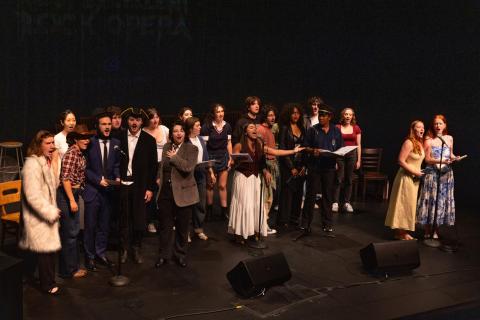
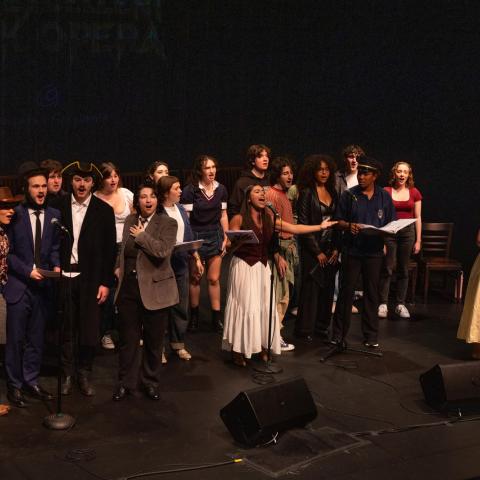
Students perform at an industry presentation of Bill & Ted's Most Excellent Rock Opera, the culmination of a nine-day developmental workshop.
Photo courtesy of Emerson College Marketing & Communications
This September, students from Berklee College of Music, Boston Conservatory at Berklee, and Emerson College had the opportunity to work alongside professional producers and creatives as part of a developmental workshop for Bill & Ted’s Most Excellent Rock Opera. Based on the 1989 comedy Bill & Ted's Excellent Adventure, the reimagined version features an original script from the movie’s co-writer Chris Matheson and an original score by Jason Lytle of Grandaddy.
While students and the production team were eager to kick off the collaboration, few knew exactly what to expect from this non-traditional project that connected emerging artists and industry veterans.
“The biggest ‘aha’ moment was on that first day,” said Anthony Tringali, a producer at Radar Pictures and a lead producer for the show. “The musicians came in and there was all this brand-new music that no one in the world had ever seen, and they mastered it in no time at all. I thought that was really impressive.”
The workshop, designed and led by Radar Pictures and Freedom Theatricals, ran September 12–20 at Emerson’s Greene Theatre and culminated in a presentation for invited industry guests. The two production teams set a goal to further develop the music and script ahead of a planned world premiere in Boston in the 2027–28 season.
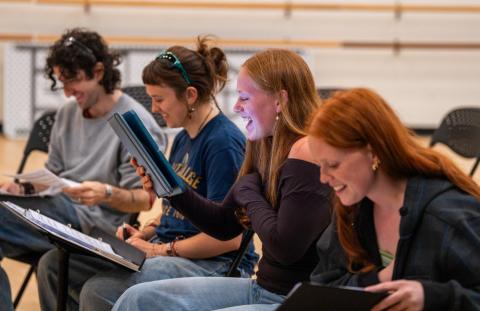
Students react during a script read-through at the developmental workshop, where they had the chance to collaborate with production and creative teams.
Photo by Alexandra Cuozzo
Throughout nine days of multi-hour sessions, the students consistently made an impact not only through their work ethic and skillful performance of the material, but through many meaningful contributions to the script and score that directly shaped the production itself.
“The music was heightened to a degree I never imagined,” Tringali said. “We have demos that our composer Jason Lytle put together for us, which are fantastic. But hearing the students and hearing the band and hearing it all come together… They truly helped create this thing. They set the template for us going forward.”
From a Berklee perspective, the workshop reflects a larger institutional effort to create career-aligned opportunities for students that allow them to take an active role in a professional environment. Collaborations like the Bill & Ted workshop, along with the recently launched Syncubator partnership with APM Music, prioritize experiential learning and engagement with industry influencers as an essential complement to classroom education.
“As students, the workshop gave many of us our first real look at a professional environment, and how committed we need to be to the material and to working closely together as actors and musicians,” said Berklee College of Music student Lucas Bohr, who played guitar and the role of Older Bill. “This wouldn’t have been possible if not granted this amazing opportunity by our respective schools and faculty.”
The high expectations that come with a professional production meant adapting to the constantly shifting demands of a new musical. Olivia Corliss, a junior at Boston Conservatory who played the role of Billy the Kid, described the importance of having flexibility and trust in the creative team.
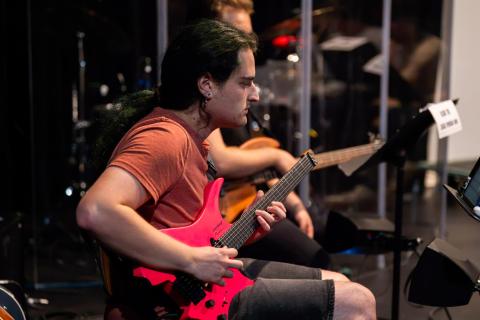
Student musicians work on a song during a workshop session.
Photo by Alexandra Cuozzo
“It felt as though [the creative and production teams] were constantly listening for and building on what each of us brought to the table,” said Corliss. “We were constantly being given new sheet music. Music director Nathan Dame and musical supervisor Jonathan Brielle would cut measures, add background vocals, and switch up voicings almost every day.”
That willingness to experiment was central to the workshop's approach. Tringali said he was particularly glad the production team had chosen to develop the show in collaboration with students rather than follow a more traditional route involving professional actors and a reading or workshop.
Given the story's origins in the Bill & Ted films, he felt that working with emerging artists offered an important perspective on what the show could become.
“[The production] is for young people, and we really want to keep this very young and fresh,” Tringali said. “They taught us a lot about what this show is and should be going forward, what's funny today, what's commercial today for young people.”
The collaboration also brought together students from three distinct academic programs, creating opportunities for relationship-building that extended beyond the workshop. Eric Paris, director of theatre operations for Emerson Stage, said he was impressed by how naturally the collaborative dynamic between the students formed.
“The students worked so seamlessly together,” Paris said. “It didn't seem like they were people from different schools. They were just one cast.”
“Each person behind the cast and crew of this wild production made it so that everyone was seen, heard, and lifted up by one another,” added Bohr. “Many of us hope to continue with this production down the line after forming such strong bonds with one another.”
That bond has gone beyond the workshop stage as many students have begun to collaborate on their own personal projects as well.
“I’m directing and producing the play POTUS at Boston Conservatory next semester,” said Corliss. “When I mentioned it, the cast and crew were all super supportive, and the stage manager at Emerson is even helping me find a stage manager for my show.”
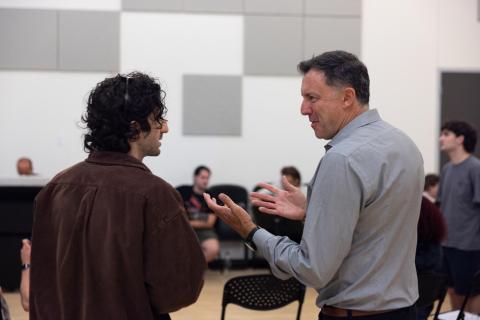
Russell Miller, co-founder and chief creative officer of Freedom Theatricals, discusses ideas with a student during a workshop session.
Photo courtesy of Emerson College Marketing & Communications
For Russell Miller, a Tony-nominated producer and co-founder and chief creative officer of Freedom Theatricals, the experience demonstrated how professional theater development and educational opportunity can work together without compromising the standards of either.
“If we can help with accessibility and inclusivity, that doesn't mean that the bar of entry gets lowered,” said Miller. “It means that more people get an opportunity to get involved, display their talent, and work with professionals to really fine-tune what they can do.”
The producers also saw potential in the approach from a practical standpoint. Bringing together students and professional creative teams to collaborate offered a development model that Miller believes could be valuable beyond this particular production.
“From a production perspective, it really works for us both operationally and creatively,” he said.
As the production team builds on the experience of the workshop with eyes on a potential Boston premiere, they emphasized their hope in maintaining relationships with the students who helped bring the project to where it is now.
“We want to have that ability to prove that this works,” Miller said. “We want to take [these students] with us as far as we can for as long as we can.”