Graduate Spotlight: Nadia Castagna
What’s it like to be a Berklee grad? Our Grad Spotlight series asks alumni all about their Berklee experience—what they learned in class, what kinds of projects they’re involved in now, how they recharge, and of course, what advice they have to share. In this installment, get to know educator Nadia Castagna MM ’19 from Rochester, New York, who studied music education (autism concentration).
Tell us about your path to Berklee. What made you decide to come here?
I got my bachelor's degree in expressive arts therapies, and wanted to go on to be a music therapist. Upon applying for [a different] grad program, I was told to basically change everything about myself before reapplying. My music theory teacher at the time noticed that I liked teaching and recommended that I get in touch with Dr. Rhoda Bernard because Berklee had a new program that was a grad degree in music education with an autism concentration that he thought I was perfect for. I got in touch with Dr. Bernard that same day, applied to the program, and got in!
What was your favorite class, and what did it teach you?
My favorite class was Elementary Classroom Methods with Pam Yanco! I learned about the Orff method and learned the most about adaptations, modifications, and how every student has a place in the music room and in the music education classroom.
When you were a graduate student, how did you typically recharge or find new ideas outside of class?
I went to conferences, bounced ideas off of colleagues, did my own research, and googled music education topics I was interested in.
What is your current job, and what do you love about it?
I work at the New England Center for Children in Southborough, Massachusetts, during the week and I work at the Berklee Institute for Accessible Arts Education in Boston on Saturdays. I love making music with my students and helping my students access music education in a meaningful way.
Music is for everyone, no matter your ability or presentation.Nadia Castagna
What's a project you've worked on since graduating from Berklee that you've been especially excited about?
There have been a couple projects I have worked on. The first is a world music curriculum that has been adapted to include abilities of all students, including students that need significant support in class. I have been working with staff members at my school (and also a couple of staff members at BIAAE) from all different countries around the world to collaborate on the lessons to make them as authentic and accessible as possible.
The second is a collaboration with my colleague, Leah Gregoire, who is an occupational therapist. We collaborated on an adapted group piano class that utilizes both occupational therapy as well as music education to ensure the success of all students at our school, no matter what their ability level is. We have presented a few times about our setup and progress in creating these classes at the ABLE Assembly at Berklee. These classes utilize occupational therapy to teach and practice the prerequisite skills needed to have success in learning and playing piano.
The third is a collaboration with my colleague Ellen Harper, who is a speech and language pathologist. We have collaborated at our school to help non-vocal verbal students who want to be part of chorus to participate meaningfully in class. Using Proloquo2go (a program used for AAC devices) we have been able to program pitch, duration, and speed of words on the device of the students that need the support in order for them to learn when and where to participate—and to blend with the chorus sound. The students practice on their own with their support teachers, and with Ellen and I, to learn timing on when to press the correct button to participate meaningfully in the chorus. We want them to be as independent as possible while in chorus while also enjoying themselves and their time.
Who's an educator that inspired you?
There have been many teachers who have inspired me throughout my career. Some that come to mind are:
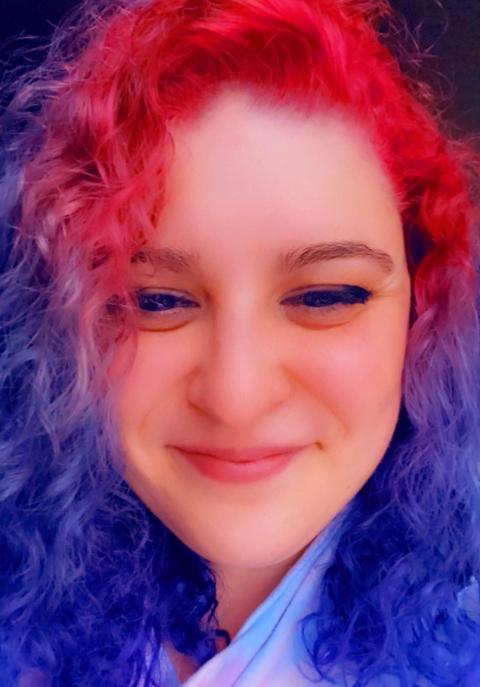
Image courtesy of Nadia Castagna
- Brian McGonagle, my high school music teacher, who helped me to start writing music, and who gave me countless opportunities in classes and in marching band. My love of mallet instruments (particularly marimba) started with him. I wouldn't be where I am today if it wasn't for moving to Massachusetts and meeting him.
- Brian Calhoon, my marimba teacher in college, and John Murphree, my music theory teacher in college, continuously encouraged me and believed in me and my abilities—even when I didn't. They saw my love for teaching and encouraged me to pursue it for my graduate degree.
- Rhoda Bernard, my advisor/professor/boss who gave me a chance to join her master's program, to become a teacher for the Saturday program BIAAE, and to become the teacher that I am today. She helped me find my dream job seven years ago, which I currently am teaching at today. She believed in my abilities—even though my undergraduate degree is in expressive arts therapies—and I never thought I would be accepted into a music school like Berklee. If it wasn't for her opportunity, I would not be where I am today.
- Pam Yanco was the first teacher I encountered at Berklee who really embodied who I wanted to be as an educator. She was fun, knowledgeable, silly, enthusiastic, and cared about how each student fit into music class no matter what abilities they had. She started my love for the Orff Shulwerk method, which seemed to be exactly the type of music education needed to teach the students I was encountering in the schools I was in.
- Krista Jadro trained me and a few of my colleagues on how to teach early childhood classes using the Gordon method. The style of her teaching really inspired me to learn more about the Gordon method and incorporate it into my teaching style. She's always been so knowledgeable and has always been available to chat and work through any questions that I have had regarding how to make class even more accessible for any of my students.
- Miles Wilcox, one of my best friends and co-teachers, has always been an inspiration. His organization and musical skills are like no other and his lessons have always been comprehensive and well-planned. We have always been co-teachers and have a similar mind on teaching. I would say we go together like peanut butter and jelly and have always been there for each other no matter what.
- Sue Langer, my advisor through my behavior analysis post-grad certification, and Chata Dickson, my professor for Evidence Based Teaching, have always believed in my abilities as a music teacher and as a behavior analyst. They've always supported me while I work to merge the two fields together. Where others have doubted that behavior analysis fits into music education and vice versa, they have doubled down that it absolutely does fit together and that each has a place in the others' field. They allowed me to experiment in the program with music education for assignments and have helped me to become an even stronger teacher than I was before.
I would not be where I am today if it was not for these teachers in my life. I thank each and every one of them for the part that they played in my life and the impact that they have left, and still leave.
When it comes to your teaching, what is something that you find rewarding?
I love making music with my students. I work at a private school for students with autism where students require moderate to significant support while learning. Schools like this do not always have arts teachers, and can sometimes have a hard time finding arts instructors willing to teach in environments where students may have significant disabilities and/or behaviors. Music is for everyone, no matter your ability or presentation. My students should not miss out on an arts education due to being who they are. They deserve educators willing to put in the time and effort into supporting them in their learning. Society tends to leave them out of consideration in many aspects, including decisions about their lives, and I would like to help change the opinion and mindset that society has about students who may need significant support. I enjoy talking about music education, collaborating with other departments like occupational therapy and speech and language therapy, as well as working on adaptations and modifications in order to incorporate everyone into music class. I love helping students access music class in whatever way is meaningful, equitable, and enjoyable for them while also offering learning in a safe and enriching environment.
Never stop fighting for music education and for your students. They deserve music.Nadia Castagna
What is something that you find challenging?
Something that can be challenging is showing admin and other staff that music is so much more than just a fun class. I mean it definitely is a fun class, however, students learn so much and demonstrate abilities that they may not demonstrate in their classrooms with tabletop work. It happens everywhere in society that music educators and musicians need to prove their worth. There is such a misconception about music education—that it is a "soft" subject and people can do without it. But music is everywhere in life, whether people value it or not. Music is just as important as other subjects in school and just as important as other professions. We have music ingrained in our systems at birth; many kids learn to sing before learning to speak.
Music education is important to a well-rounded education. Not only is it teaching new musical skills, it is also allowing students to come into the classroom and generalize skills that they have already learned and expand them in a functional way. Music is more than just a leisure skill, it's a lifelong learning process. Yes, music is something that people learn to do in their leisure time, but also it provides cognitive stimulation in the form of coordination skills, communication skills in groups, executive functioning skills, self-expression, and even more than I am listing here. Finding a way to reach admin, staff, or even people in our society to constantly advocate for music education and the benefits it provides for individuals is crucial as a music educator. Advocating is part of the job—that's why it is taught in music education programs. Work hard to keep the good fight going. Never stop fighting for music education and for your students. They deserve music.