Student Spotlight: Alan Catz
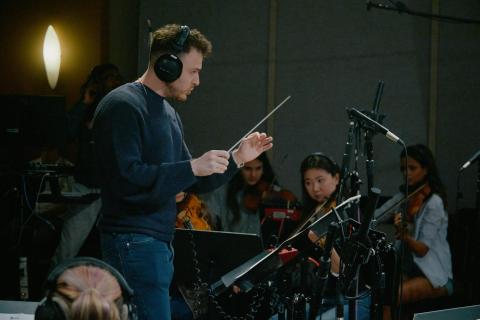
Image by Ken Yin
What’s it like to study at Berklee? Our Student Spotlight series asks current students all about their Berklee experience—what they’re learning in class, what kinds of projects they’re involved in onstage or behind the scenes, how they recharge, and of course, what they’re listening to. In this installment, get to know composer Alan Catz, a ninth-semester student dual majoring in film and media scoring and game and interactive media scoring (GAIMS) from Buenos Aires, Argentina.
You can follow him on Instagram, LinkedIn, and his website.
Tell us about your path to Berklee. How did your journey in music begin, and what made you decide to come here?
I started music late, when I was 19, but I had always had a deep love and sensitivity for it. Before Berklee, I studied computer science and psychology, and until I was 19, I didn’t have a single friend who was connected to music or even played an instrument. I was completely outside of that world, and I didn’t really have a way to learn more about it. I didn’t even know what a conservatory was!
Everything changed when I met Olga Sakovich, a Russian pianist and violinist who had just moved to Buenos Aires, completely by chance. After a few months, she encouraged me to apply to Manuel de Falla, one of the best music conservatories in Argentina. At the time, that made absolutely no sense to me. I’ll always remember how surreal my first day there felt, when I walked in and heard all the musicians practicing their instruments in different isolated rooms—instruments that, of course, I didn’t even know existed, yet I knew I had finally found a purpose in my life.
Later, I was recommended to take lessons with some of Argentina’s top concert pianists, Fernanda Morello and Manuel Fraga, as well as film composer Eric Kuschevatzky. Eric is a Berklee alumnus who had worked with Randy Newman, and he was one of the first reasons I became interested in Berklee. He was also the first person who showed me how a film score actually worked, and I was completely hooked. From that moment on, I knew there was no going back. I didn’t grow up inside the music world; I had to find the door first. Berklee brought out the best in me and pushed me further than I ever thought possible.

Catz in FILM-440
Image by Ken Yin
What's been your favorite class so far, and what has it taught you?
My favorite time at Berklee was in Advanced Orchestration for Film, taught by Tim Huling. It’s one of the most competitive classes in the Screen Scoring Department, with only six students accepted each year. I’m incredibly grateful I had the chance to be part of it.
This class was all about composing, orchestrating, preparing, recording, and conducting one- to three-minute cues with a full orchestra every two weeks. We worked like professional composers for an entire semester; each cue had to be written, notated, rehearsed, recorded, and conducted within a very short timeframe.
I learned so much about orchestration, recording techniques, score preparation, and how to communicate clearly in a session. That class gave me a lot of confidence, and it made me feel much more prepared to conduct my own sessions and take on bigger projects when I move to Los Angeles.
What's a project you've worked on since coming to Berklee that you've been especially excited about?
One of the happiest days of my life was when the trailer for League of Legends: Wild Rift–Crystal Rose was released in 2023. I had the chance to work on the music alongside my longtime friend Ignacio Ramírez, and it was an incredibly special experience. As a League player myself, seeing my arrangements, orchestration, and piano featured in a Riot Games trailer felt surreal, and it’s something my inner child still can’t quite believe.
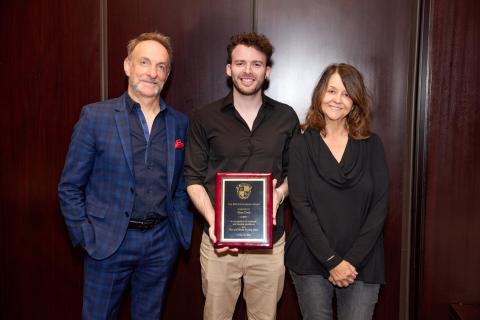
From left: Mychael Danna, Alan Catz, and Tracy McKnight in Boston, after Catz was presented with Berklee’s 2024 BMI Award.
Image by Kelly Davidson
You received Berklee’s BMI Award in 2024. Can you tell us more about what that recognition meant to you?
Berklee has helped me turn what used to feel like a distant dream into something much more real. In 2024, I received Berklee’s BMI Award, an honor given to the most distinguished student in the Screen Scoring Department. That recognition became a major turning point for me, both personally and professionally. It changed my life completely.
Through the award, I had the chance to meet and be mentored by Academy Award– and Golden Globe–winning composer Mychael Danna, as well as Tracy McKnight, Vice President of Creative for Film, TV, and Visual Media at BMI. Their guidance has meant a lot to me, both creatively and professionally, and helped me understand how to take the next steps in my career.
I was also extremely fortunate to be invited to attend the BMI Film, TV & Visual Media Awards in 2025. Being in that room, surrounded by so many composers whose work I deeply admire, felt completely surreal. I even got to meet Thomas Newman, one of my favorite film composers of all time. Moments like that made me realize how much Berklee has opened doors for me, and made the industry feel much closer than it did when I first arrived.
What opportunities at Berklee helped you gain confidence as a composer in the game music industry?
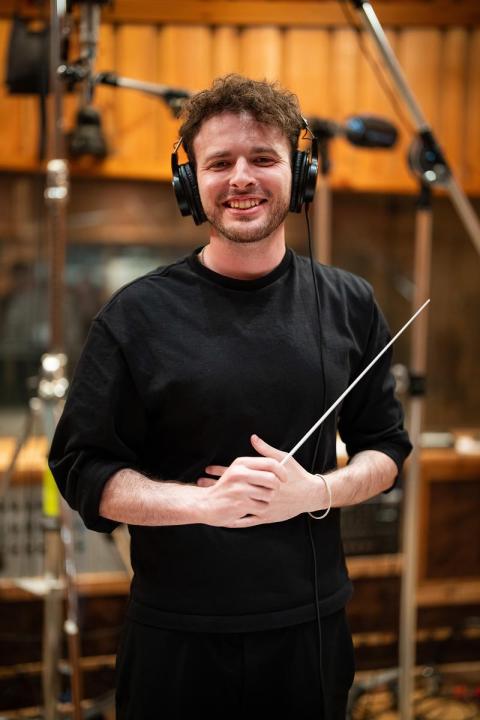
Catz at Power Station at Berklee NYC
Image by Ryan Nava
As someone who grew up loving games, some of the most meaningful opportunities I had at Berklee were the ones that made the game music industry feel closer and more real. Winning a Berklee competition with Ubisoft and presenting my music to Ubisoft Music Supervisor Simon Landry was one of those moments. I also participated in the Riot Games challenge at Berklee, where I wrote music based on a brief connected to Riot and, after being selected among many talented game composers, presented my work to Bill Hemstapat, an extremely skilled composer and music designer at Riot Games.
Those experiences meant a lot to me because they were not just competitions; they were moments where I got to receive feedback from people working in the industry I had dreamed about for years. They helped me understand that the work I was doing at Berklee could exist beyond the classroom.
I’ll always be grateful to one of my key mentors, Nacho Gonzalez, who helped create these opportunities and guided me through so much of my path at Berklee. I was also selected as one of five students worldwide to be fully sponsored by the Game Audio Network Guild, which allowed me to represent Berklee at GDC 2026, the Game Developers Conference, one of the most important events in the video game industry.
What has been the biggest challenge you’ve faced during your Berklee journey?
One of the biggest challenges has been facing the reality that I started much later than most people around me. I came to Berklee very aware that many students had grown up in musical families, started playing when they were children, and had been breathing music their whole lives. Being surrounded by musicians with so much talent and experience was inspiring, but also very humbling.
But if there is one thing I’m proud of, it’s this: no matter how late I started, I’m willing to work as hard as it takes to become the version of myself I want to be. Starting late gave me urgency, discipline, and a very clear sense of purpose.
Another big challenge has been the language and cultural transition. Spanish and English are very different, and Argentina and the United States have very different cultures. At times, I felt frustrated because I couldn’t always find the perfect word or the exact way to fully express my personality in English. I knew what I wanted to say, but I sometimes had to simplify it. Over time, I learned to be more patient with myself and to trust that connection does not always require perfect language.
Despite those challenges, I’ve achieved so many of the things I came here hoping to accomplish. I also found wonderful friends who I’ll take with me into my new life in Los Angeles. I found my place at Berklee, and looking back, coming here was the best decision I could have ever made.
I didn’t grow up inside the music world; I had to find the door first. Berklee brought out the best in me and pushed me further than I ever thought possible.Alan Catz
How important has your twin brother been in your journey as a composer?
Uri has been by my side my entire life. Having a twin is a very special bond, and it’s almost impossible to explain. I always say the same thing: the best thing that ever happened to me was having him as my brother and my ally for life.
He keeps me grounded, not only in my path as a composer, but in life since day one. I’ve shared everything with him, and he has been there through every major decision, every difficult moment, and every step of this journey.
Funny enough, he is also a film and game composer, and we share the same dream. I’m really lucky. He is my creative partner in almost everything I do. Having someone next to me who is not only extremely talented, but also has a trained ear and is not afraid to give me brutally honest feedback on my music, has been incredibly important. He helps me stay clear, focused, and humble.
Everything I do in life, I feel like I’m doing for both of us. No matter what challenge life puts in front of me, I know I’ll be able to get through it if he’s there with me.
Alan Catz's Top Five Film and Game Scores
We asked Alan to give us five of his favorite media scores. Here's what he said:
1. "Forest Calling," Bill Brown, from the game Lineage II
This is from my favorite video game and soundtrack of all time. Bill Brown, a Berklee alumnus, made me fall in love with the music from the very first time I played the game. I have so many beautiful memories connected to this OST [original soundtrack], and I still listen to it to this day. I even recorded a piece at Power Station with the same title, as a tribute to him and to how much this music has meant to me.
2. "Concerto 〜Brotherhood〜," Akira Senju, from the anime FullMetal Alchemist
This is the story of two brothers, should I say more?
3. "Recollection I," Shiro Sagisu, from the anime BLEACH The DiamondDust Rebellion
Shiro Sagisu will always be my favorite composer of all time. He can literally write anything. Always so emotional, extremely beautiful melodies, orchestral colors and textures. He can create any type of emotion.
4. "a tender feeling," Yuki Kajiura, from the anime Sword Art Online
One of the most beautiful pieces I ever heard and one of the reasons I fell in love with Japanese music.
5. "Define Dancing," Thomas Newman, from the film WALL-E
As I mentioned, he is my favorite film composer. He has such an effortless ability to create introspective, nostalgic, emotional, and beautiful sound worlds. Whenever he scores a film, I feel immediately pulled into its world.