At the Intersection of Music and Dance, an Epic Collaboration
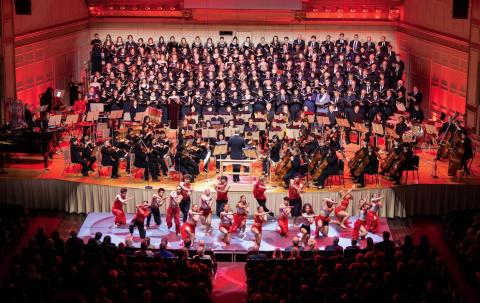
Boston Conservatory singers, dancers, and instrumentalists performing Carmina Burana at Symphony Hall, with the Back Bay Chorale and Boston Children’s Chorus
All photos by Michelle Parkos
Boston Conservatory at Berklee partnered with Boston’s preeminent community choral group, Back Bay Chorale (BBC), for a performance of Carl Orff’s Carmina Burana in May, lending its three choirs, a full student orchestra, and 11 Conservatory soloists for a sold-out performance at Symphony Hall. Conducted by Dr. Stephen Spinelli (who serves as both music director of the Chorale and director of choral studies at Boston Conservatory), well over 200 singers brought life to Orff’s monumental—and well-loved—cantata, while students from the Conservatory’s commercial dance program performed original choreography created by faculty members Leah Abbott and Jun Kuribayashi.
Capping off the Chorale’s 50th anniversary season with a bit of spectacle, Spinelli and BBC executive director Susanne Powers chose Carmina Burana as a piece of “gateway” repertoire—something to intoxicate new audiences and get them hooked on choral music, while at the same time pleasing classical aficionados and longtime patrons of the Chorale. Carmina Burana has the power to do both, with a heady mix of drama, humor, and melodies that get lodged in your head for days.
Performing it as Orff intended—with hundreds of voices, orchestra, and dancers—is a massive undertaking. Through Spinelli’s connections to both institutions, the Chorale found enthusiastic partners in Boston Conservatory’s Music and Dance divisions; and Boston Children’s Chorus joined in as well, singing parts that Orff originally composed for a boys choir.
Bringing fresh perspective to Carmina Burana was important to Spinelli, and he challenged his students to approach the work with intention. “If you’re going to do a piece that’s so ubiquitous, you really should ask yourself, ‘What do I have to say about it? And how can it be newly revealed as something with interest?’” he says.
“Dancing with the musicians”
Because Orff envisioned Carmina Burana as a scenic cantata, new choreography would be a crucial component of the performance. Boston Conservatory musicians and dancers collaborated directly over the span of many weeks, exploring the repertoire together and finding creative overlap in the music- and dance-making processes.
“I’ve never worked at a school with such a present and excellent dance program,” Spinelli said. “Ever since I got here, one of the thoughts I had was, ‘Well, this program is amazing. How do we learn from what they’re doing?’”
To embody Carmina Burana’s tales of flirtation, carousing, gambling, and loss, faculty choreographers Abbott and Kuribayashi drew inspiration from contemporary dance companies Pilobolus and MOMIX, emphasizing “body sculpture, acrobatic partnering, optical illusion, the bodies becoming something unusual but relatable somehow,” Kuribiyashi says. “What pulled us in most was the visceral, almost ritualistic quality of Orff’s score. The way it cycles between tenderness and uproar.”
Initially, the dancers rehearsed with a recording of Carmina Burana, but it soon became clear they needed to practice with live musicians. Spinelli brought his conducting students into the dance studio for three weeks of rehearsal, to accompany the dancers on piano, study the score in relation to the choreography, and work on issues like tempi and pacing. As the choreography evolved, student dancers brought new contributions to the movement, helping to shape the final result.
“The orchestra was a body in the room with us. And the relationship moved from ‘dancing to the music’ to ‘dancing with the musicians.’”
—Jun Kuribayashi, Associate Professor of Dance
Moving to live music is altogether different from recorded music, and requires a heightened awareness from the dancers, Kuribayashi says. With a recording, the body quickly settles into expected patterns, but with live music, “the tempo varies, the pauses in the playing and singing vary, the way a ritardando lives or doesn’t live in the room varies,” he says. “The dancers have to listen with their bodies in real time instead of trusting a recording’s metronome.”
Performing with the orchestra "made everything more alive,” he adds. “The orchestra was a body in the room with us. And the relationship moved from ‘dancing to the music’ to ‘dancing with the musicians.’”
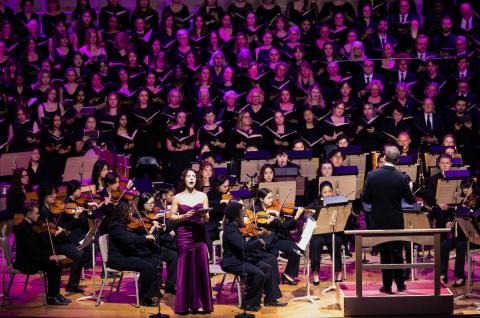
Soprano Nicole Di Pasquale (BM '26, MM '28, voice) performs “Stetit puella” from Carmina Burana.
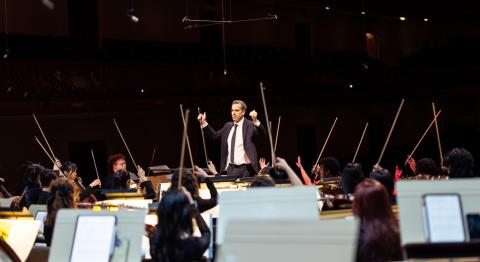
Stephen Spinelli, director of choral studies at Boston Conservatory and music director of Back Bay Chorale, leads the Boston Conservatory Orchestra in rehearsal.
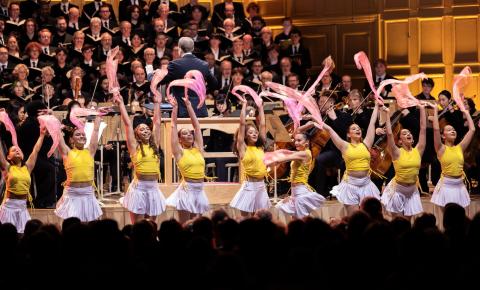
Students from Boston Conservatory’s commercial dance program perform in Symphony Hall.
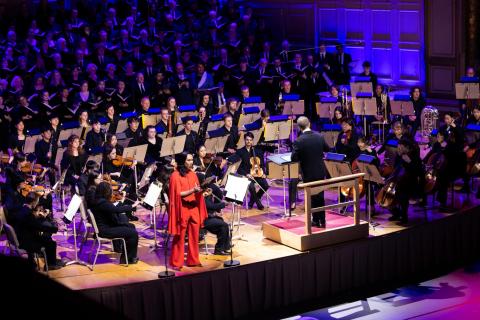
Baritone John Tuvera-Lim (GPD '27, voice) performs “Dies, nox et omnia.”
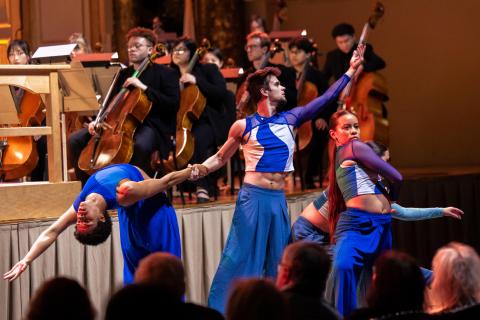
Student dancers perform choreography by faculty members Jun Kuribayashi and Leah Abbott.
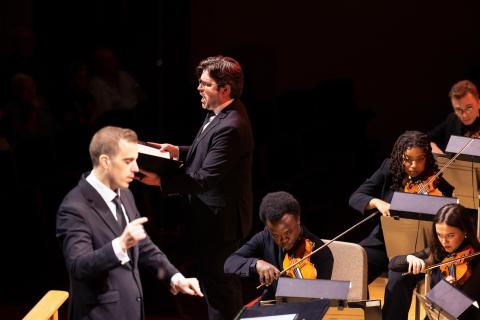
Michael Hanely (center), associate professor of voice, performs “Estuans interius” as conductor Stephen Spinelli (left) leads the Boston Conservatory Orchestra.
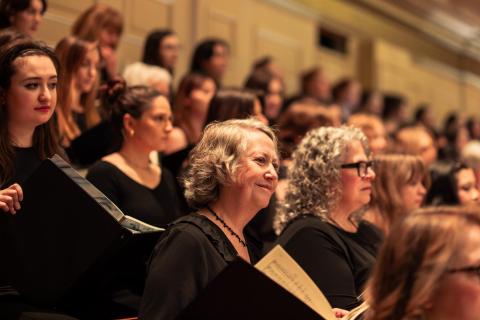
Boston Conservatory’s three choirs shared the stage with members of the Back Bay Chorale.
“Physically creating sound”
The orchestra’s instrumentalists brought their own physicality to the performance, in parallel with—and enhanced by—the dancers. The scale of Carmina Burana asks a lot of its musicians: enormous vocal sound, booming percussion, and flurries of pizzicato in the string parts. “It’s clear [Orff] was playing with this idea of embodying the music, getting the musicians really involved in physically creating sound,” Spinelli says.
Watching dancers interpret the cantata alongside the orchestra, Spinelli says, reminded him that music is a gestural artform, not just an aural one. “The way [the dancers’] feet are leaving the ground and returning is what that bass drum does. When that bass drum player hits that drum, it’s an artistic thing—it is dance. And conducting is dance,” he says.
Working at the intersection of two art forms—exploring their similarities and noting their differences—was “a huge learning experience for me,” Spinelli says, and it introduced his students to new creative possibilities.
“It’s the kind of educator moment where your heart feels like it’s going to explode. One of your students is playing the piano for a dance class, and one of them is conducting, and a bunch of kids are dancing—I was like, this is it,” he says. “This is exactly where I want to be working and teaching and thinking. And these are the kinds of projects that we need to be doing.”