Student Spotlight: Keziah Thomas
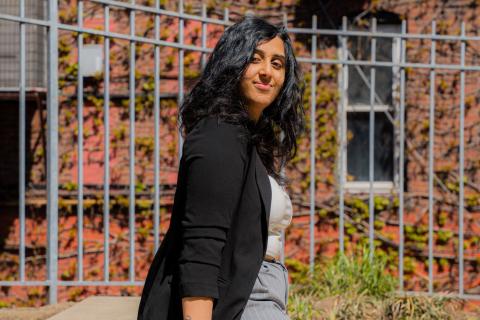
Image by Aine Lindsay
What’s it like to study at Berklee? Our Student Spotlight series asks current students all about their Berklee experience—what they’re learning in class, what kinds of projects they’re involved in onstage or behind the scenes, how they recharge, and of course, what they’re listening to. In this installment, get to know composer Keziah Thomas, a seventh-semester major in film and media scoring and minor in conducting from Bangalore, India.
Keziah was named the Berklee College of Muisc student commencement speaker for the class of 2026. You can follow her on Instagram, LinkedIn, and her website.
Tell us about your path to Berklee. What made you decide to come here?
My journey began at age seven, when I started composing simple melodies on the piano. At the time, I didn’t realize this would become my life’s path; I was just exploring and having fun. Over the years, I experimented with different instruments and eventually discovered music production. At 14, after watching Charlie Puth break down his song "Attention," something clicked—I knew I wanted to produce and compose music. That moment led me to begin studying audio engineering at 15, where I immersed myself in recording, mixing, mastering, and production. But even then, something felt like it was missing.
Everything changed when I was introduced to a post-production module during my diploma course and discovered film scoring. The moment I began writing music to pictures, I knew I had found my path. I realized how powerfully music can transform the meaning of a scene, and I knew I wanted to be part of that process. Around that time, I was deeply inspired by Ramin Djawadi’s work. When I learned that he studied at Berklee College of Music, I started looking into the program and from that moment on, I knew Berklee was where I wanted to be.
What's been your favorite class so far, and what has it taught you?
Oh, this is such a hard question because I have so many favorites, but I would say Intro to Composition & Orchestration for Media Composers and Dramatic Orchestration for Film, both with Tim Huling, stand out the most.
Before coming to Berklee, I was already well-versed in music production, but it wasn’t until these classes that I truly began to understand orchestration and the depth that goes into composing for live instruments. Tim is incredibly knowledgeable, and I learned so much from the way he approaches writing.
These classes completely changed how I think about music. I hadn’t realized how important it is to understand each instrument, its range, timbre, and unique character, before writing for it. I didn’t even know what extended techniques were before coming into these classes, and discovering them opened up an entirely new world of sound possibilities for me. Learning how to shape emotion and storytelling through orchestration was a turning point for me, and those classes played a huge role in my growth as a composer.
What's a project you've worked on since coming to Berklee that you've been especially excited about?
My favorite project so far is actually outside of film scoring. I was part of the Berklee Techno Sampling and DJ Ensemble, taught by Isabella Koen, and for our final exam, we all had to perform a live techno set at the nightclub Manray. I played a techno B2B set with my classmate Daphne, and I truly had so much fun.
I love DJing because it’s completely different from composing. It gives me a creative outlet and a space to reset when I need a break from scoring. I really enjoyed blending melodic elements into the techno set, and also incorporating elements of my own culture to make the set feel personal and unique. It was such a freeing and energizing experience.
How do you typically recharge or find new ideas outside of class?
Outside of class, I usually recharge by stepping away from music for a bit and immersing myself in things that feel completely different, like spending time with friends, binge-watching shows, playing board games/card games, painting, and more. It allows me to create without pressure and return to music with a clearer, more refreshed mindset.
I also find a lot of inspiration in watching films and TV shows, especially by paying attention to how music shapes the emotion on screen. Often, just observing how a scene feels—without overanalyzing the theory behind it—helps me come up with ideas naturally when I’m composing.
I think my best ideas usually come when I’m not actively trying to force them, but when I’ve stepped back and allowed myself to fully experience things.
I don’t just want to write music for myself. I want my work to empower others, to remind them that their passion is worth pursuing, even if it feels uncertain.Keziah Thomas
When you think toward your own future, who inspires you most?
Not to sound like everyone else, but I am very inspired by composers like Ramin Djawadi, Hans Zimmer, Ludwig Göransson, and Cristobal Tapia de Veer. Each of them inspires me in different ways through their storytelling, orchestration, sound design, and emotional depth. I’ve taken elements I admire from all of them, which has ultimately shaped my own approach to hybrid scoring.
Beyond creative inspiration, I’m deeply inspired by people who lead with determination and persistence. As a woman composer from India, I’ve often had to push against doubt and limitation. I’ve had people tell me that this is not a sustainable career and that it is “just a hobby.”
Through all of that, my parents have been my biggest source of support. I am incredibly grateful to them for believing in my talent and supporting my decision to come here even when the path felt uncertain. They remind me every day why representation matters, why seeing and hearing voices like mine can open doors for others. That’s why I don’t just want to write music for myself. I want my work to empower others, to remind them that their passion is worth pursuing, even if it feels uncertain.
What's one piece of advice you'd give to your high school self?
Trust the timing of your journey and don't compare yourself to others along the way. I spent a lot of time comparing myself and feeling like I hadn’t achieved what they had, but I’ve learned that everyone is on their own timeline. Looking back, every stage, every setback, every shift in direction, every moment of uncertainty, was necessary in shaping who I am as a composer today. So I would remind myself that I don’t need to measure my journey against others, because everyone is on their own path.
Keziah Thomas's Top Five Film and Game Scores
We asked Keziah to give us five of her favorite media scores. Here's what she said:
1. "Main Title," Theodore Shapiro, from the TV show Severance
This cue is so unique in its simplicity and tension. The piano melody feels both familiar and unsettling at the same time, which I love. I also love how minimalistic it is, yet it builds such a strong sense of atmosphere and curiosity without needing to overexplain itself.
2. "Destroyer of Worlds," Ludwig Göransson, from the film Oppenheimer
I love how this track shifts so seamlessly from a calm, introspective opening into a much more tense, anxiety-filled atmosphere [the shift is around 1:30]. The transition is so emotionally powerful, it slowly pulls you into a completely different headspace without ever feeling abrupt.
3. "Rest of Our Lives Together," Kris Bowers, from the TV show Queen Charlotte
I love how tender and emotionally honest this piece feels from the very beginning. The simplicity of the writing allows every harmonic shift to be meaningful. The warmth and intimacy in the orchestration really stays with you, and it beautifully captures the feeling of love, reflection, and vulnerability.
4. "Light of the Seven," Ramin Djawadi, from the TV show Game of Thrones
I watched this scene before I had even seen Game of Thrones. The way it builds and intensifies toward that final explosion completely captivated me; it felt so powerful and intentional that it made me watch the show after. This is also the first track that got me into film scoring.
5. "Winston's Offer," Joel J. Richards and Tyler Bates, from the film Ballerina
I really love the synth textures and sound design on this track, especially how it creates such a dark, immersive atmosphere. The vocal echoes that come in around the 40-second mark are my favorite part; it adds so much character and detail to it.