Graduate Spotlight: Gabrielle Rodriguez
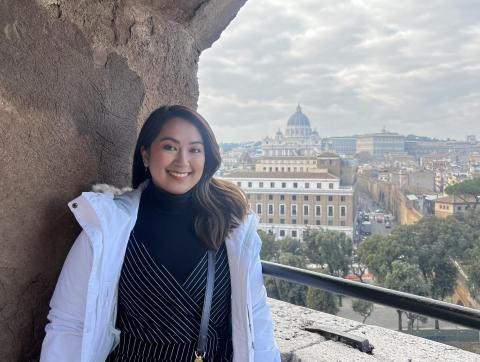
Image courtesy of Gabrielle Rodriguez
What’s it like to be a Berklee grad? Our Grad Spotlight series asks alumni all about their Berklee experience—what they learned in class, what kinds of projects they’re involved in now, how they recharge, and of course, what advice they have to share. In this installment, get to know educator Gabrielle Rodriguez MM ’23 from Manila, Philippines, who studied music education (autism concentration). You can follow her on Instagram.
Tell us about your path to Berklee. What made you decide to come here?
When my nephew was diagnosed as being on the autism spectrum, it completely changed the way I looked at my role as a music educator. I knew I wanted to specialize in music and autism so I could better understand and support learners like him. While researching programs, I found that Berklee was the only school offering exactly what I was looking for. I took it as a sign that I was meant to be there. Berklee’s prestige and reputation for producing outstanding musicians also gave me the confidence that I would be learning from the best. It felt like the right place to grow both as an educator and as a person.
What was your favorite class, and what did it teach you?
I loved all my classes at Berklee and had incredible teachers whose lessons I carry with me to this day. One class that truly stood out was Autism, Music, and Behavioral Teaching Methods with Professor Victoria LaRiccia. This class changed many of my misconceptions and biases about students with autism. My classmates were so experienced, and I learned from each one of them. The class setup encouraged open discussion, questioning, and challenging ideas that didn’t feel right. It pushed me beyond my limits and helped me see a more student-centered approach. I stopped fearing mistakes and started viewing them as opportunities to learn.
When you were a graduate student, how did you typically recharge or find new ideas outside of class?
I’ve always drawn strength from my family and friends back home. Even with the time difference, I would call them whenever I felt stuck or needed to feel grounded. Those conversations reminded me why I came to Berklee in the first place. I also worked with Berklee Institute for Accessible Arts Education (BIAAE) while I was there, and my students gave me new ideas all the time. They challenged me in the best way and helped me see teaching from different angles. I can honestly say I learned the most from them.
What is your current job, and what do you love about it?
I recently worked at a music school in Singapore, where I focused on training teachers and developing a curriculum for young children. That’s when I realized how much more needs to be done for inclusivity in music education. I love mentoring teachers, sharing what I learned at Berklee, and seeing them become motivated to better meet students’ needs. In September, I returned to the Philippines to establish an inclusive music program that’s accessible and to share my knowledge with fellow Filipino educators.
I stopped fearing mistakes and started viewing them as opportunities to learn.Gabrielle Rodriguez
What's a project you've worked on since graduating from Berklee that you've been especially excited about?
I’m currently building my own music studio in the Philippines, which will focus on inclusivity and accessibility. It’s still in the works, but I’m very excited to see it come to life.
Who's an educator that inspired you?
Without a doubt, Dr. Rhoda Bernard. She’s an incredible role model to me. When faced with a challenge, she always seems to have a hundred possible solutions. I secretly call her “Superwoman” because of the sheer number of things she manages to accomplish—and all at such a high standard. Her work, especially through BIAAE, is exactly the kind of initiative I hope to bring to the Philippines. She’s shown me what’s possible when passion meets action.
When it comes to your teaching, what is something that you find rewarding?
Being part of my students’ learning journeys is my greatest motivation. When parents are involved and supportive, I feel even more fulfilled because it means we’re working together to give their child the best support possible. I also love discovering unique talents, like a student of mine who can name the exact metronome marking of a piece just by hearing a short section. Incredible! Seeing them grow as musicians and break stereotypes is truly rewarding.
What is something that you find challenging?
Though teaching can be challenging, I approach it with ease by meeting students where they are. What I do find more challenging is shifting societal beliefs about disabilities. Sometimes I encounter educators or parents who already have misconceptions about autism and see limitations where there shouldn’t be any. It takes time to change those mindsets, just as it took time for me to shift my own thinking and understanding of inclusivity. That’s why I keep doing the work, hoping that little by little, more people will start to see things from a different perspective.