
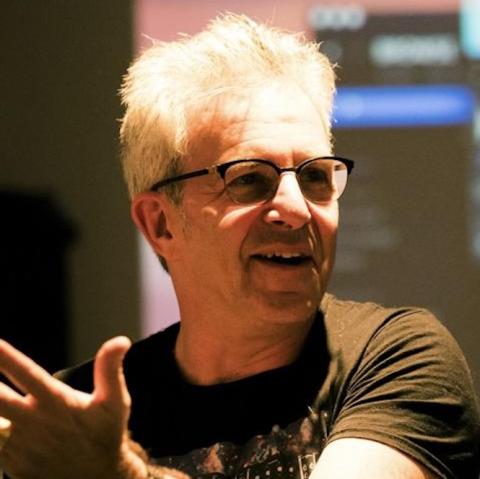
Jonathan Wyner
Jonathan Wyner is head of artistic technology initiatives for the Berklee Emerging Artistic Technology Lab (BEATL), an instructor at Berklee Online, and former professor of music production and engineering at Berklee College of Music. He is also chief engineer at M Works Studios in Somerville, Massachusetts, and past president of the Audio Engineering Society (AES).
A musician, producer, mastering engineer, educator, and technology advisor, Wyner has mastered and produced thousands of recordings. His credits include James Taylor, David Bowie, Aerosmith, Kiri Te Kanawa, Aimee Mann, Miles Davis, Thelonious Monk, Pink Floyd, Bruce Springsteen, Nirvana, Josh Groban, and many others.
His career has long focused on the intersection of music, technology, and education. From driving CV triggers on an ARP 2600 synthesizer from his French horn in the late 1970s to his current work with artificial intelligence, he has remained fascinated by how new technologies can expand creative expression while serving the goals of artists. At BEATL, Wyner works with artists, educators, and industry leaders to explore AI and other emerging technologies through the lens of real musical practice, addressing questions of creativity, authorship, identity, and artistic impact.
As an advisor to music technology companies, he brings the perspective of working musicians and educators into the design of creative tools. He collaborates with product and engineering teams to help ensure that new technologies support musical quality, intuitive workflows, and authentic creative practice. His advisory work includes collaborations with iZotope, Suno, Softube, and Moises.
Wyner is the author of Audio Mastering: Essential Practices (Hal Leonard/Berklee Press) and has developed undergraduate and graduate courses for Berklee Online. He received two TEC Awards for Best Educational Software and was a Grammy nominee in the Best Classical Crossover Album category for Invention and Alchemy by Deborah Henson-Conant and in the Best Latin Jazz Album and Best Instrumental Composition categories for Crisálida by Danilo Pérez. His work continues to bridge artistic practice, audio engineering, education, and the future of music technology.