
Middle Eastern Modes
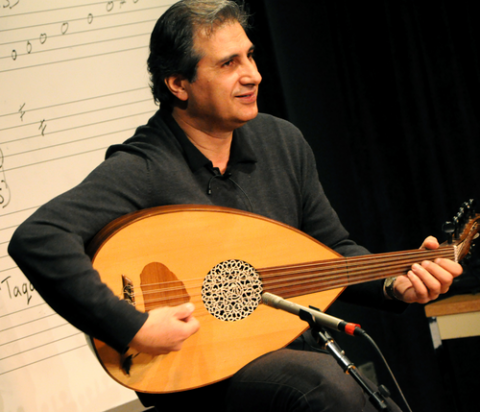
Arabic classical music has flats, half-flats, and everything in between. Saba demonstrates how a single note is played in a subtly different place on the oud depending on context.
Photo by Phil Farnsworth
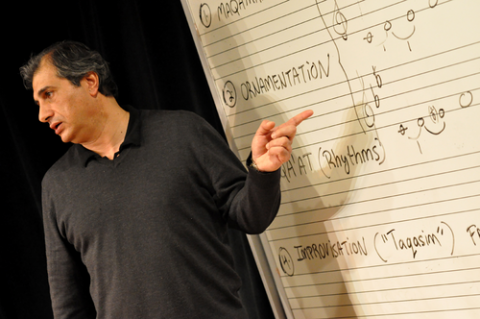
Saba diagrams two maqāmāt: rast and hijaz. "Everyone is familiar with this scale because we live under the shadow of the Hollywood industry," he says, improvising a Lawrence of Arabia-like melody in the hijaz mode. "Definitely—there is the camel!"
Photo by Phil Farnsworth
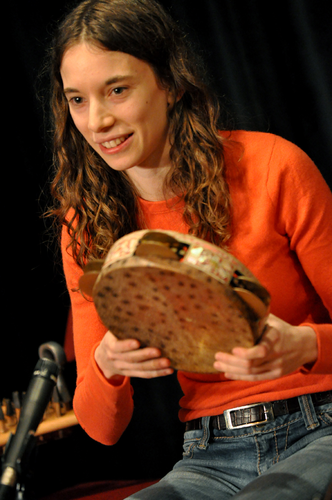
Percussionist April Centrone demonstrates the different sounds she can play on the riqq. "I consider this the Arabic drum set," she says. "It has so many voices."
Photo by Phil Farnsworth
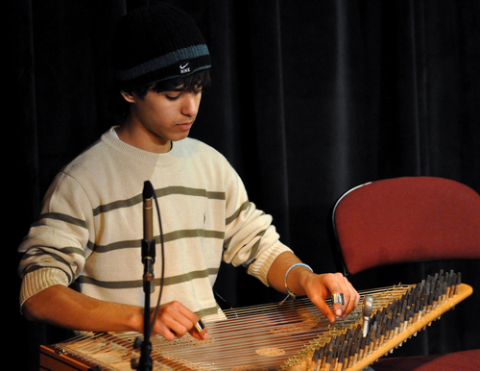
Qanún player Ali Amr has only been at Berklee for a month, but at age 12 he came from Palestine to study with Saba. Amr says, "It's an honor for me to play with him. I always wanted to."
Photo by Phil Farnsworth
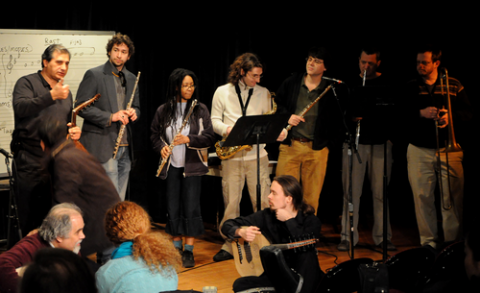
The impromptu ensemble isn't limited to Middle Eastern instruments. A trombone in Arabic music? Why not, says Berklee harmony professor Dave Harris: With its slide, "I can play all the cracks. It's not traditional, but it seems like a natural."
Photo by Phil Farnsworth
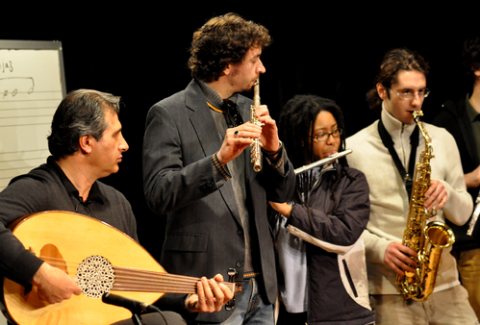
Saba has attendees repeat after him, saying, "Listen to the subtle syncopation I'm doing." Although the sheet music doesn't show it, players ornament the basic melody lines, giving the phrase "a very rich quality," Saba says.
Photo by Phil Farnsworth
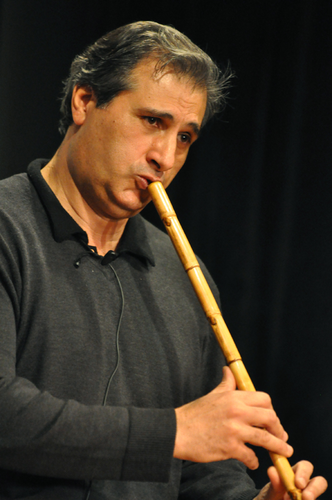
Saba, shown here playing the ney, considers music a cross-cultural bridge. "Music, it can be a language for everyone on earth," he says.
Photo by Phil Farnsworth
Berklee presented an impressive preview for its first-ever Middle Eastern music festival on February 18: an intense clinic with Lebanese oud and nay expert Bassam Saba.
Later that day, Saba would perform at the BPC with his own group and the Berklee All-Star Middle East ensemble—a concert organizer/voice professor Christiane Karam called "exciting and exhilarating," with "incredible energy" in the room.
But first, in under two hours, he took a packed recital hall through the complex basics of Arabic classical music. Percussionist April Centrone and Berklee student Ali Amr assisted.
Saba, a member of Yo-Yo Ma's Silk Road Project, outlined and demonstrated the key differences with Western classical music in abbreviated yet detailed form.
The two came together in medieval Andalusia, Spain, where Iraqi musician Ziryâb established the earliest academic music school, Saba said. You can hear the influence on Western music in Baroque cadenzas.
To the Western ear, the key differences are microtones and modes. Western classical music long ago settled on one mode—the familiar white-and-black piano key sequence. Arabic music uses many, called maqāmāt, that employ half-flats and other notes between the cracks. (Saba had handouts.)
The clinic wasn't all academic, though—far from it. Saba invited anyone with an instrument to come up and play. He led an impromptu 15-person ensemble through several variations on a few lines of traditional songs.
"This is an important event," Saba said after the clinic. For him, connecting different audiences with Arabic music "is a duty and a pleasure."
View the photo gallery to learn more about the clinic.